Feb
16
Remembering Supreme Court Justice Antonin Scalia
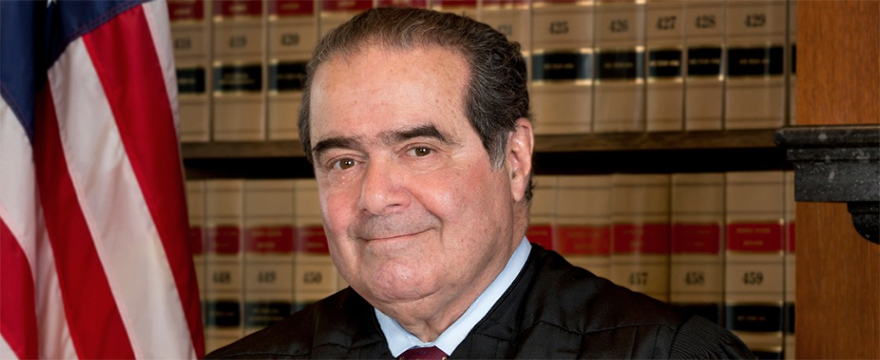
On Saturday February 13, 2016, Justice Antonin Gregory Scalia, the nation’s first Italian-American Justice and the unrivaled anchor of the conservative wing of the Supreme Court, passed away at age 79. President Obama, in his remarks to the nation, praised Justice Scalia as a brilliant legal mind who influenced a generation of lawyers and students. As an associate Justice of the highest court in the land—whether you liked him or not, agreed with his decisions or not, considered yourself a constitutional originalist or not—there can be no dispute that Justice Scalia has been an undeniable force in our nation’s constitutional discourse over the better part of the last three decades.
Justice Scalia was nominated to the Supreme Court by President Ronald Reagan in 1986. Throughout his almost thirty years of service on the High Court, he established a solidly conservative voting record and a consistent constitutional ideology. He has been described as the intellectual anchor for the originalist and textualist positions in the U.S. Supreme Court’s conservative wing, advocating for the treatment of the Constitution as a “dead” document rather than a “living” (evolving) one. He embraced an approach that prioritized the original meaning of the text of the Constitution without regard to “changing times” or an “evolving” society or the “intent” of the founding fathers. He was a strong defender of the death penalty and the powers of the executive branch, believing that presidential power should be paramount in many areas. He opposed gay rights, abortion rights, affirmative action and other policies that treated any minority as special groups. He filed separate—many times, dissenting—opinions in several cases where he often castigated the Court’s majority in his opinions using scathing language, colorful writing and searingly pointed rhetoric.
The passing of Justice Scalia, arguably the intellectual cornerstone of the Court’s conservative wing, could lead to a shift in the balance of power on the Supreme Court—from a 5-4 conservative majority to a 5-4 liberal majority. With the judicial balance of power at issue, the appointment of Justice Scalia’s successor is certain to become a major issue in the ongoing presidential race, with stark divisions emerging over whether his successor on the Court should be nominated by the current President or the next. Also, with the ideological DNA of the court hanging in the balance, there is no question that this next appointment (if it happens in his term) could make this “Obama’s court” and eventually prove to be a lynchpin of his Presidential legacy. It is not surprising that the President has already announced his intentions to nominate a successor, saying he plans to fulfill his constitutional responsibility to fill the vacancy.
Whether you considered yourself a fan or a foe, it is hard to deny that we have lost an intellectual giant on the Court and a Justice that has shaped, in his image, our constitutional discourse for decades to come. But even if you didn’t like him, as Justice Scalia himself said, in an interview with Charlie Rose in 2012, “[a] man who has made no enemies, is probably not a very good man.”
Here are some excerpts from Justice Scalia’s opinions/dissents:
U.S. v. Windsor (The Defense of Marriage Act, 2013 (dissent)): “We have no power to decide this case. And even if we did, we would have no power under the constitution to invalidate this democratically adopted legislation. The Court’s errors on both points spring forth from the same diseased root: an exalted conception of the role of this institution in America. “The court is eager — hungry — to tell everyone its view of the legal question at the heart of this case . . . That is jaw dropping. It is an assertion of judicial supremacy over the people’s Representatives in Congress and the Executive.”
Shelby County v. Holder, No. 12-96. (voting to throw out a key provision of the Voting Rights Act regularly renewed by Congress): “Whenever a society adopts racial entitlements, it is very difficult to get out of them through the normal political processes. I don’t think there is anything to be gained by any Senator to vote against continuation of this act. “And I am fairly confident it will be enacted in perpetuity unless — unless a court can say it does not comport with the Constitution.”
Lawrence v. Texas, (dissenting from 2003 opinion against anti-sodomy laws): “(Laws) prohibiting sodomy do not seem to have been enforced against consenting adults acting in private . . . I do not know what ‘acting in private’ means; surely consensual sodomy, like heterosexual intercourse, is rarely performed on stage.” “Many Americans do not want persons who openly engage in homosexual conduct as partners in their business, as scoutmasters for their children, or as boarders in their home. They view this as protecting themselves and their families from a lifestyle that they believe to be immoral and destructive.”
Ohio v. Akron Center for Reproductive Health (dissent): “The Constitution contains no right to abortion. It is not to be found in the longstanding traditions of our society, nor can it be logically deduced from the text of the Constitution — not, that is, without volunteering a judicial answer to the nonjustifiable question of when human life begins. Leaving this matter to the political process is not only legally correct, it is pragmatically so.”
Stenberg v. Carhart (abortion dissent): “The notion that the Constitution of the United States designed, among other things, ‘to establish Justice, insure domestic Tranquility . . . and secure the Blessings of Liberty to ourselves and our Posterity’, prohibits the States from simply banning this visibly brutal means of eliminating our half-born posterity is quite simply absurd.
United States v. Virginia (dissent on ruling against male-only admission at VMI): “The tradition of having government-funded military schools for me is as well rooted in the traditions of this country as the tradition of sending only men into military combat. “The people may decide to change the one tradition, like the other, through democratic processes; but the assertion that either tradition has been unconstitutional through the centuries is not law, but politics smuggled into law.
Arizona v. United States (dissent, court ruling on state law against undocumented residents): “We are not talking here about a federal law prohibiting the states from regulating bubble-gum advertising, or even the construction of nuclear plants. We are talking about a federal law going to the core of state sovereignty — the power to exclude. “The Court opinion’s looming specter of inutterable horror — ‘if Sec. 3 of the Arizona statute were valid, every State could give itself independent authority to prosecute federal registration violations” — seems to me not so horrible and even less looming. “If securing its territory in this fashion is not within the power of Arizona, we should cease referring to it as a sovereign state.”
Cherine Smith Valbrun, is a Partner at Kim Vaughan Lerner LLP. She is one of the 17th Circuit representatives on the Florida Bar Young Lawyers Division Board of Governors and a Past President of the Caribbean Bar Association.